
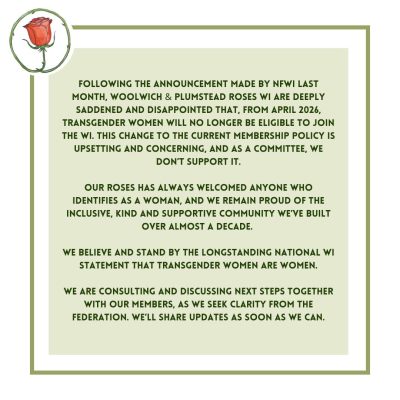
Not up to speed with the events that have led to the changes to the WI’s Membership rules? Don’t worry, we’ve put together a quick factsheet.
Legal Standing & Decision Context
- Supreme Court Ruling:
The court ruled that “Women = biological women” is the new legal definition of woman under Equality Law. The EHRC (Equalities and Human Rights Commission) guidance on applying this ruling remains outstanding (an interim update last year was later withdrawn in October). - Charity Law Constraints:
The WI (like the Girl Guides) operates under a single-sex exemption from the Equality Act. The Charity Commission prioritises provision for women as a protected characteristic (now defined as above – AFAB — Assigned Female At Birth- ‘biological women’). - Trustee Responsibility:
Unlike the Good Law Project, which has the resources to fund high-risk “test cases”, WI Trustees have a legal duty to protect the charity’s funds. Spending membership money on risky legal battles and on priorities beyond the scope of the charity’s stated ‘Objects’ would be a breach of trustee duty. It could also bankrupt the organisation, and Trustees would be liable.
External Challenges & Threats
The WI is currently navigating significant external pressures, including:
- Coordinated Campaigns:
Evidence of organised movements (e.g., Mumsnet, Sex Matters) and journalists “masquerading” as members to find and publicise internal conflict. - Legal Litigation:
Constant legal threats over (at least) the last seven years, including:- Direct discrimination claims brought by cisgender men.
- Challenges to the Charity Commission on breaches of trustee roles.
- The WI Board’s Position:
The Board and Council fought hard for full inclusion, believing it is crucial. While the Supreme Court decision has made inclusive legal membership impossible for now, the WI has reaffirmed the institutional belief that “trans women are women.”
The WI Path Forward: Sisterhood Groups and how they might work
Since legal membership must remain single-sex now defined as AFAB, the WI is introducing Sisterhood Groups as a way to remain as inclusive as possible within the law. We are awaiting further information about how these groups might work, this is what we know so far.
- Legal Status:
These are “sub-groups” or “affiliates” rather than formal membership spaces. To be legally sound, they must technically be open to all, including men (because they will not have the exemption from the Equality Act). - Ethos:
The core principle is that “transgender women are women.” Within these groups, this ethos is protected and cannot be challenged or debated. - Local Autonomy:
Each local WI has the power to decide whether to form a Sisterhood Group. It is an optional enabler, not a mandate.
Flexibility & Logistics
- The “11 Meetings” Rule:
WIs must hold 11 formal membership meetings a year. However, there are no rules on how or when the 11 meetings happen, or on what else is also provided. Trustees (the Committee) must ensure ‘value for money’ in return for the membership fee for members. - Activity Integration:
Many current WI activities happen outside formal meetings. These can be transitioned into the Sisterhood Group structure. - Fee Structure:
WIs can offer these activities free for members, while non-members (including trans women and others) pay a small participation fee.
Alternative paths forward: transitioning out of WI to form a new, autonomous ‘Roses’ group
- How would such a group work?
Work, time and leadership would be needed to plan and implement. We are in touch with groups who have already done this and/or intend to, who are sharing information.
Legal Status: As a community group the group could be inclusive for trans women. We are taking advice and think that currently such a group would not be legally required to admit cis men, if the stated purpose and ethos was to be a safe space for women (including trans women), as a space shaped around women’s lived experience.
Ethos: The core principle would be that “transgender women are women.” Within the group, this ethos would be protected and not subject to challenge.
Finance: We would need a membership fee to cover insurance, venues etc. However we would have ownership of 100% of the membership fees, unlike the WI fees which are shared with National and local Federations.
The Roses Committee Stance
We’re deeply disappointed by the change. The Roses is built on inclusivity. Not being able to offer formal membership to trans women goes against everything we’ve built over the past decade. Several Committee members are standing down (two were planning to do so anyway) which will leave all three critical officer roles empty. If the three officer roles are not filled, we’ll be unable to form a Committee and the Roses group will have to close, at least as a ‘WI’ group.